Closing a quarter
Book depreciation, bank charges and a bad-debt write-off, review the trial balance, file GSTR-1, lock April–June 2026, and post a late correction under an exception
Cedar Components closes its first quarter, April to June 2026, in the first week of October. Ada Lovelace is the owner, Priya Nair the accountant and Meera Iyer the company’s CA (Chartered Accountant). The close follows the order your CA expects: adjusting entries first (corrections that make the period’s figures complete), then review, then a check against the GST (Goods and Services Tax) return filed in July, then the locks, which close the period to new entries.
| Step | Who | Page |
|---|---|---|
| 1. Book depreciation, bank charges and a bad-debt write-off | Accountant | Journals |
| 2. Review the trial balance (every account’s balance) for the quarter | CA | Trial balance |
| 3. Check the GST outward register (the list of sales for the return) against the GSTR-1 filed by its due date | Accountant, CA | Reports |
| 4. Lock the books and the tax period through 30 Jun 2026 | Owner or CA | Locks |
| 5. Post a late correction under a short exception (time-limited permission to post into a locked period) | Owner grants, accountant posts | Locks |
The quarter at a glance
In April to June Cedar Components raised one invoice in Edernal Books: INV26-27/5 of 12 Jun 2026 to Orion Fabrication, for two mounting brackets at ₹800 each plus 18% GST (CGST and SGST, the central and state halves of GST on a sale within one state, ₹144 each), ₹1,888.00 in all, due on 27 Jun 2026. Orion never paid.
1. Book the adjusting journals
The accountant posts (enters for good) three journals, manual entries, all dated 30 Jun 2026, before the period is locked. Adjusting entries go in first so that nobody needs an exception for them.
Depreciation
Plant and machinery is depreciated at 10% a year, straight line (the same amount each year): ₹18,500 for the quarter. Depreciation is the share of an asset’s cost used up in the period. Cedar added Depreciation (expense) and Accumulated Depreciation (asset) in the chart of accounts first. The chart of accounts is the list of all your accounts. In the tables below, Dr and Cr are the debit and credit, the two equal sides of every entry.
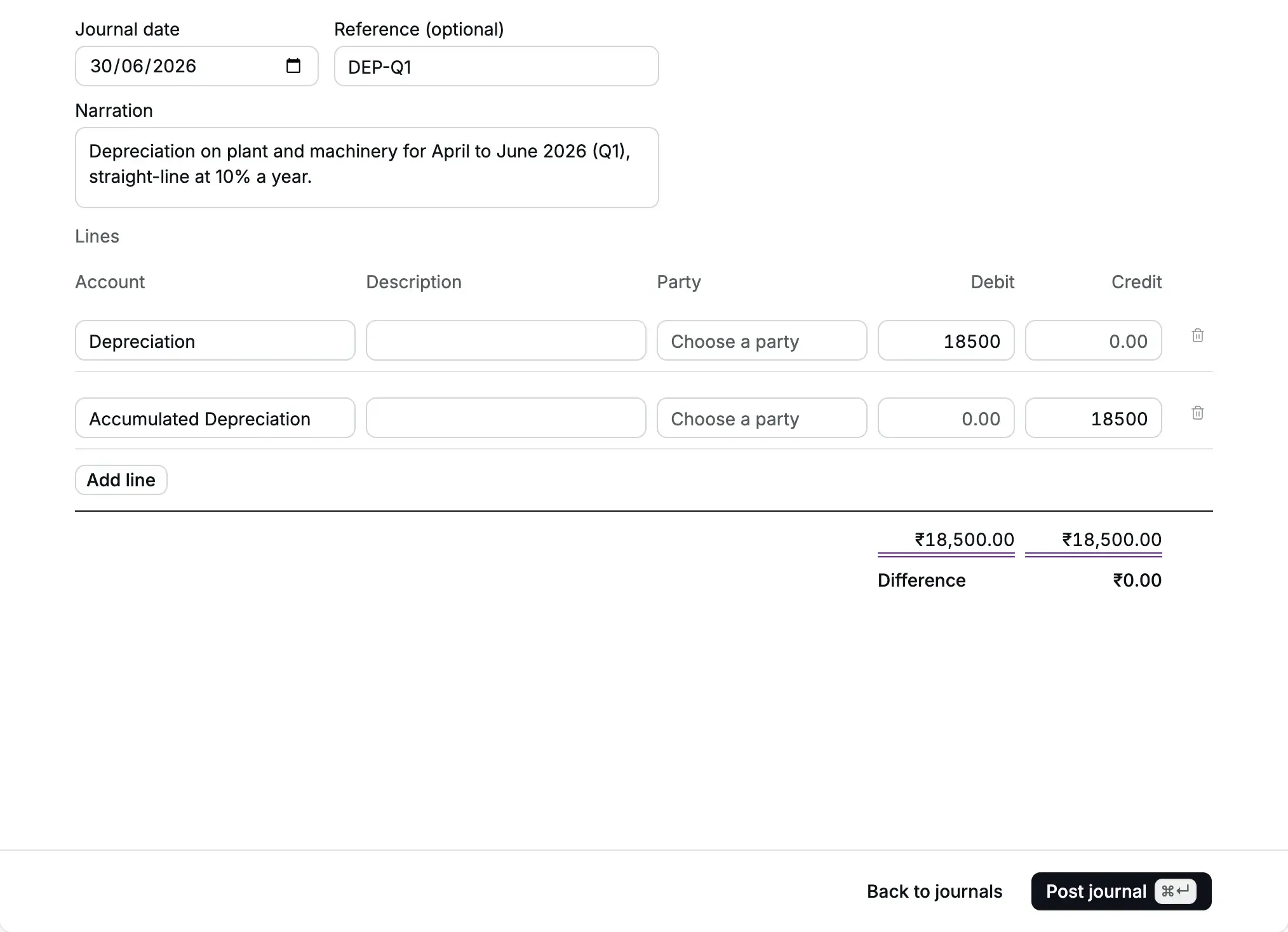
JV26-27/2 · 30 Jun 2026 · DEP-Q1 |
Dr | Cr |
|---|---|---|
| Depreciation | ₹18,500.00 | |
| Accumulated Depreciation | ₹18,500.00 |
Bank charges
The June statement of the current account shows ₹590 for NEFT (bank transfers), SMS alerts and a cheque book. Cedar books it gross, without claiming the GST in it.
JV26-27/3 · 30 Jun 2026 · STMT-JUN-26 |
Dr | Cr |
|---|---|---|
| Bank Charges | ₹590.00 | |
| Bank Account | ₹590.00 |
To claim input tax credit (ITC, the GST you paid that you may deduct from the GST you collect) on bank fees, enter them as a bill from the bank instead.
Bad-debt write-off
Orion Fabrication has closed its Bhosari unit. The owner decides to write off INV26-27/5 in full, GST included, because GST law gives no refund of output tax (the GST charged on the sale) on a bad debt, money a customer will never pay.
The accountant adds a line on Accounts Receivable (what customers owe, a
control account) with Party Orion Fabrication (the
party is the customer) and a credit of 1888. The Open invoices grid shows INV26-27/5; she
clicks Fill to settle it from this journal. This allocation
matches the credit to that invoice.
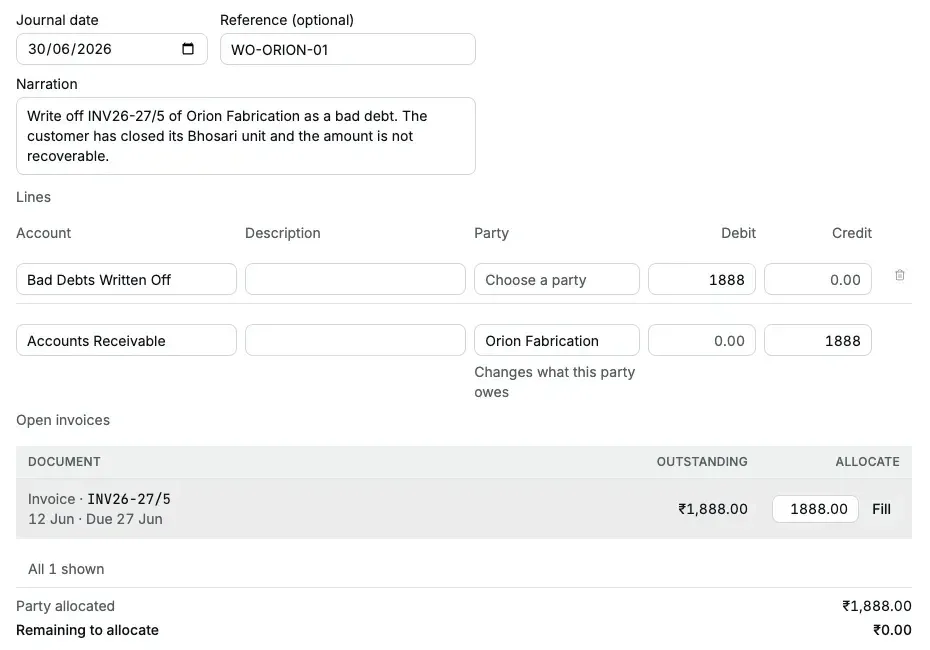
JV26-27/4 · 30 Jun 2026 · WO-ORION-01 |
Party | Dr | Cr |
|---|---|---|---|
| Bad Debts Written Off | ₹1,888.00 | ||
| Accounts Receivable | Orion Fabrication | ₹1,888.00 |
INV26-27/5 now has nothing outstanding (unpaid), and Orion’s party ledger, the running record of everything with one customer, reads: invoice ₹1,888.00 Dr on 12 Jun, journal ₹1,888.00 Cr on 30 Jun, balance ₹0.00.
2. The CA reviews the trial balance
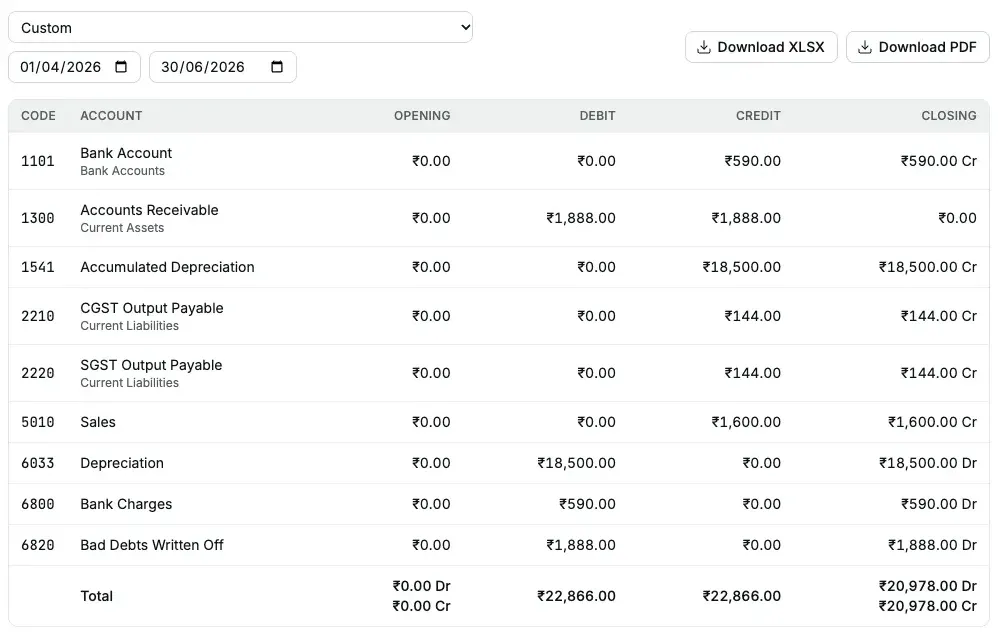
Meera opens Trial balance and sets From 01/04/2026
and To 30/06/2026. She checks each balance against the working papers and
clicks Download PDF to save a copy for her file.
3. Check the GST register against GSTR-1
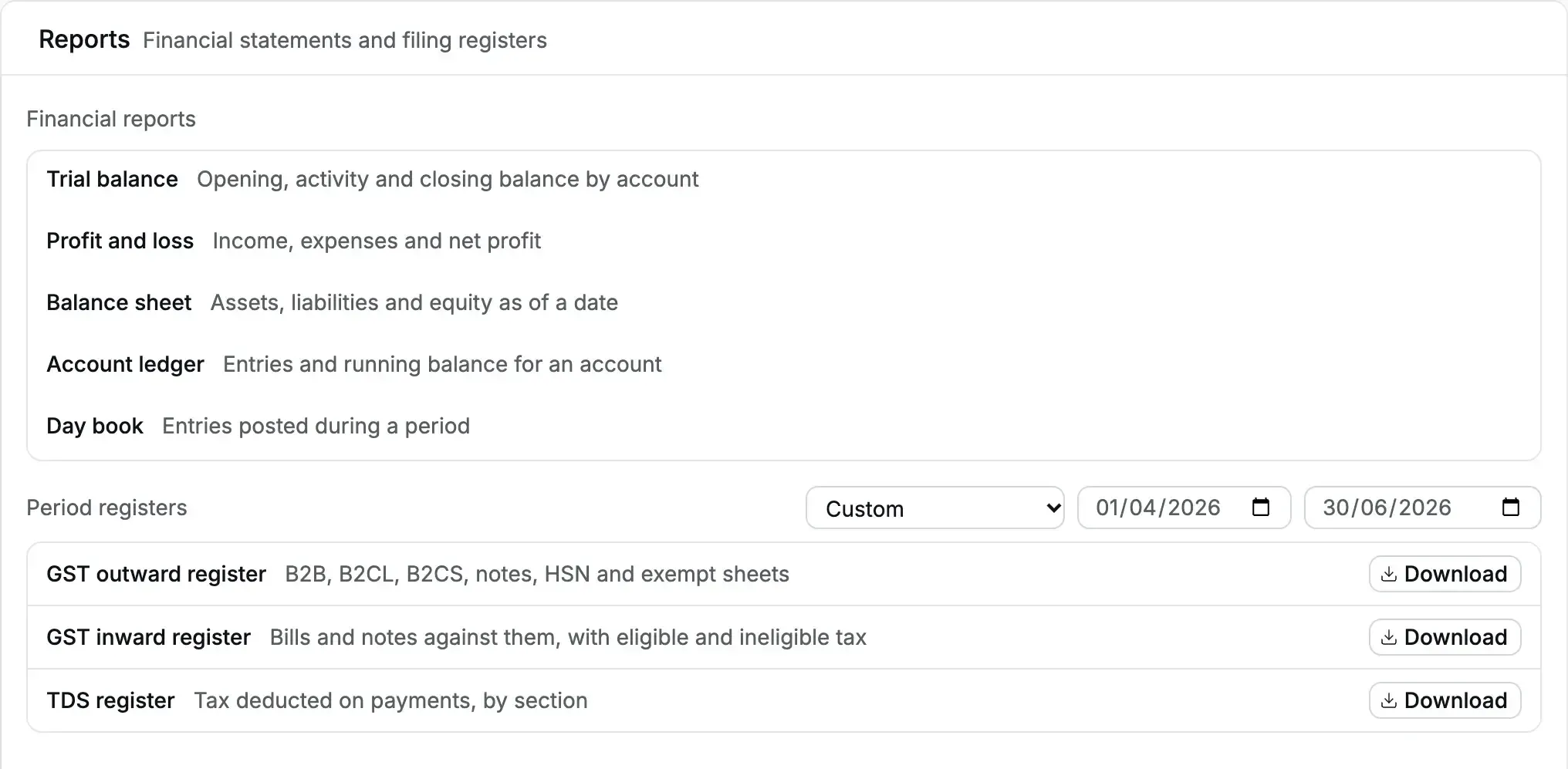
On Reports, under Period registers, the accountant sets the dates to
01/04/2026 and 30/06/2026 and clicks Download Excel on GST outward register. The
workbook has the sheets B2B, B2CL, B2CS, CDNR, CDNUR, HSN and
Exempt. Orion has no GSTIN (GST registration number) and the
supply is within Maharashtra, so INV26-27/5 is summarised in B2CS (sales to
unregistered buyers): place of supply 27 (the state
code for Maharashtra), rate 18%, taxable ₹1,600.00, CGST ₹144.00, SGST ₹144.00. The
HSN sheet shows the same amounts under HSN 7326 (HSN, the
goods classification code on the invoice).
The CA filed GSTR-1 for the quarter on the GST portal from this workbook by its due date (for a quarterly filer, 13 Jul 2026; check the date that applies to you with your CA). Because the books close only in October, the accountant downloads the register again now and checks that it still matches the return already filed. Edernal Books does not file returns itself.
4. Lock the books and the tax period
With the review done and GSTR-1 filed, the owner opens Settings → Locks:
- Books → Change lock → Locked through
30/06/2026, reason “Q1 2026-27 closed. Depreciation, bank charges and bad-debt write-off booked; trial balance reviewed by the CA on 4 Oct 2026.” → Save lock. - Tax period → Change lock →
30/06/2026, reason “GSTR-1 for April, May and June 2026 filed; GST outward register for Q1 matches the return.” → Save lock.
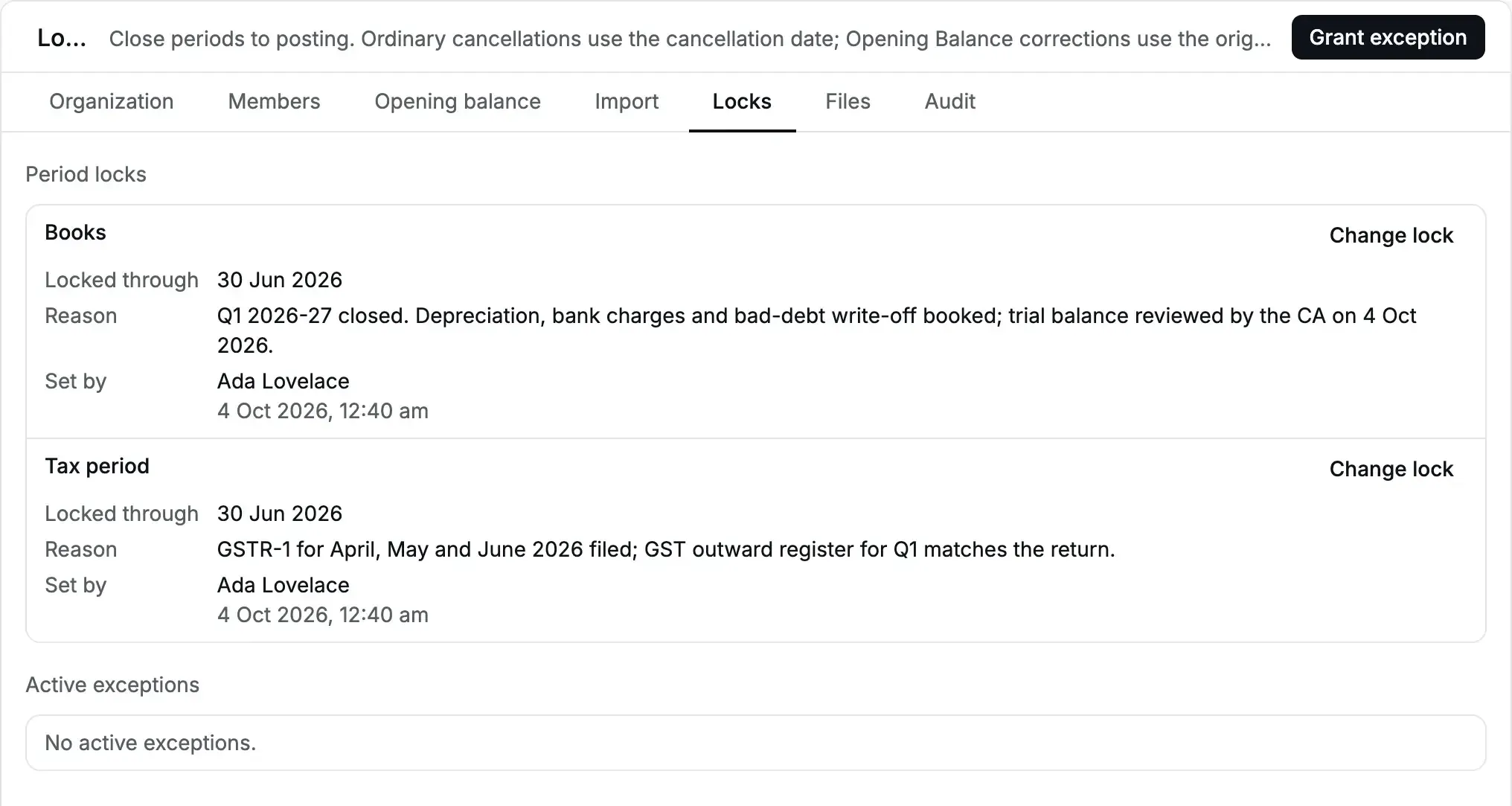
From now on, nobody can post a document dated on or before 30 Jun 2026. July’s work continues as normal.
5. A late correction
On 4 Oct 2026, while finalising the quarter’s figures, Meera notices that the CNC lathe installed on 15 May 2026 was left out of the depreciation working. The missing charge is ₹2,250.
The accountant enters a journal dated 30 Jun 2026: Dr Depreciation ₹2,250, Cr
Accumulated Depreciation ₹2,250, reference DEP-Q1-ADJ. Posting is refused:
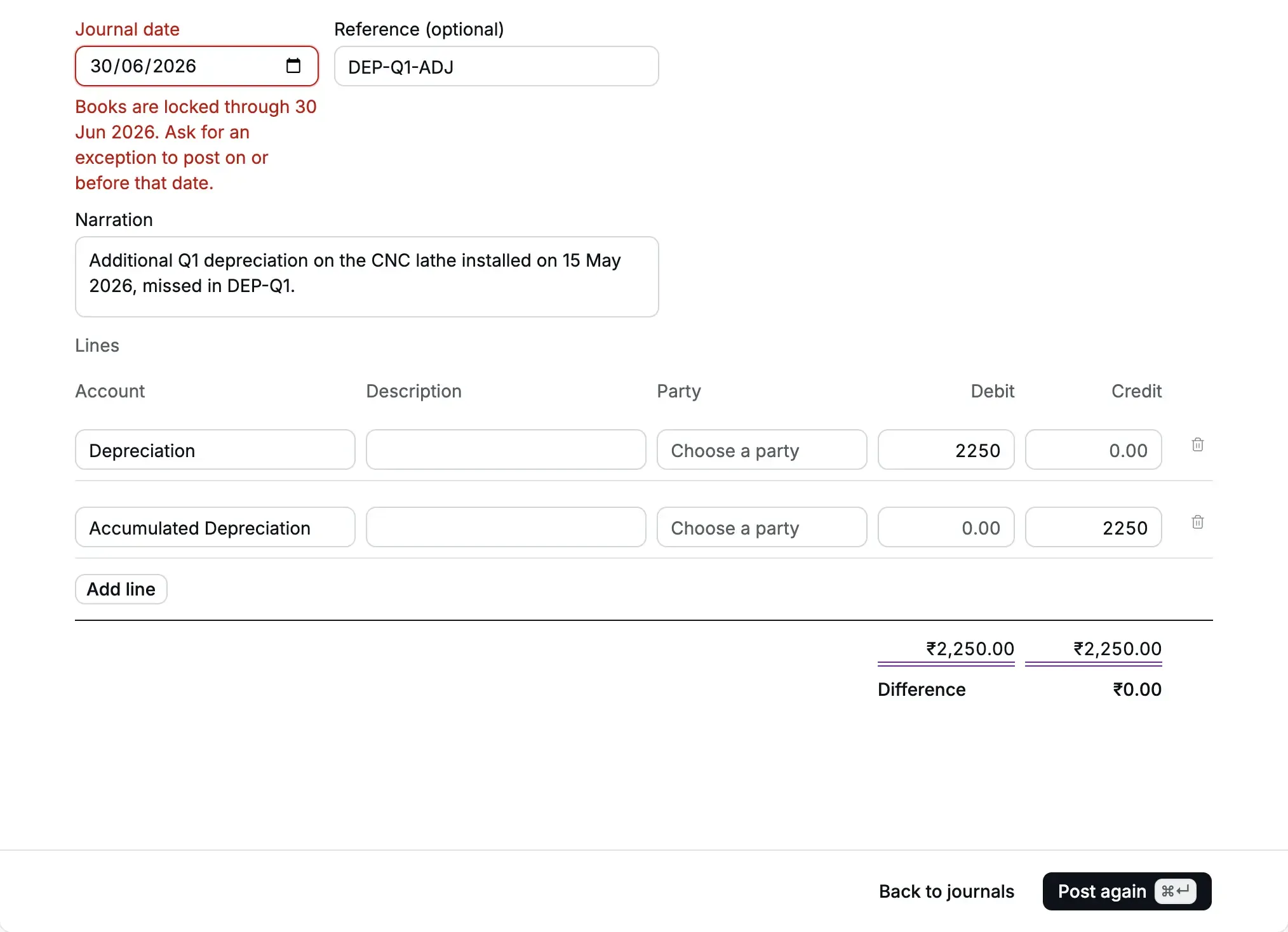
The owner clicks Grant exception on Settings → Locks, chooses the member who will post, and chooses 1 day in For how long, with the reason “Post the missed Q1 depreciation on the CNC lathe (DEP-Q1-ADJ), as agreed with the CA.” The journal form keeps the entry, so the accountant clicks Post again, and JV26-27/5 posts on 30 Jun 2026.
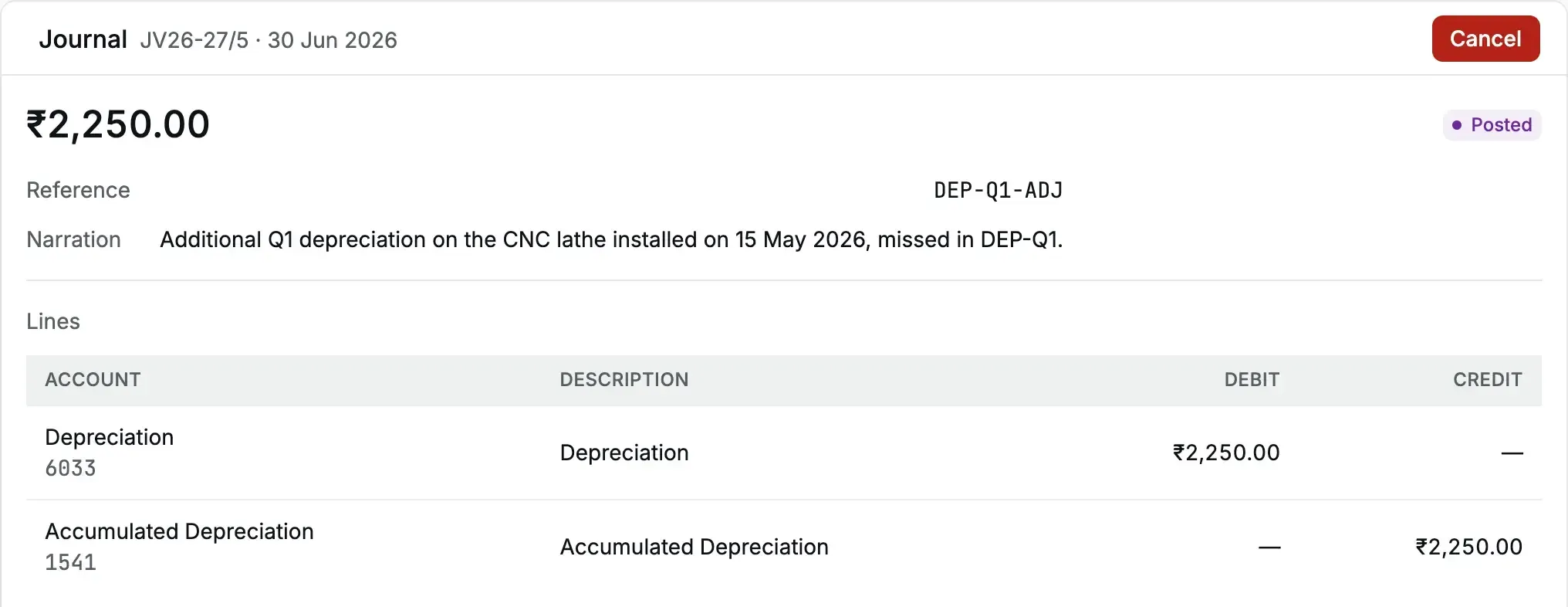
JV26-27/5 · 30 Jun 2026 · DEP-Q1-ADJ |
Dr | Cr |
|---|---|---|
| Depreciation | ₹2,250.00 | |
| Accumulated Depreciation | ₹2,250.00 |
The owner then clicks Revoke so the exception does not stay open. A test posting dated 30 Jun is refused again with “Books are locked through 30 Jun 2026. Ask for an exception to post on or before that date.” The grant stays in Settings → Audit, the audit log of sensitive actions, as “Lock exception granted”, with the member’s name and email, the number of days and the reason.
This correction journal names no GST accounts, so the tax lock did not need to move. Had the CA found a wrong GST invoice instead, the fix would be a credit note dated in October (a credit note reduces an invoice you already issued), not a change to June.
The closed quarter
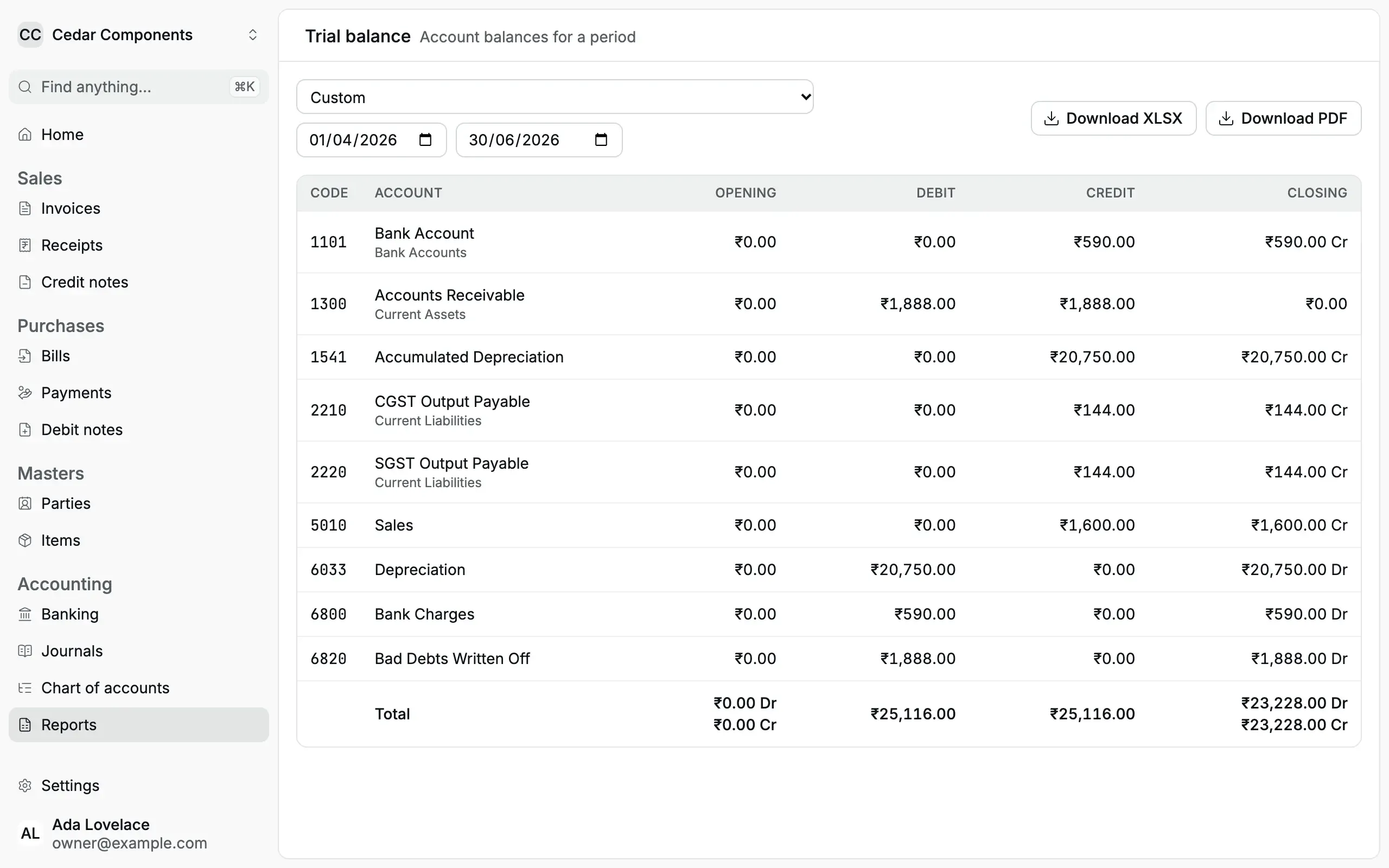
| Account | Closing Dr | Closing Cr |
|---|---|---|
| Bank Account | ₹590.00 | |
| Accounts Receivable | ||
| Accumulated Depreciation | ₹20,750.00 | |
| CGST Output Payable | ₹144.00 | |
| SGST Output Payable | ₹144.00 | |
| Sales | ₹1,600.00 | |
| Depreciation | ₹20,750.00 | |
| Bank Charges | ₹590.00 | |
| Bad Debts Written Off | ₹1,888.00 | |
| Total | ₹23,228.00 | ₹23,228.00 |
Accounts Receivable is ₹0.00: the June invoice and its write-off cancel out. The quarter’s income is ₹1,600.00 and its expenses ₹23,228.00, a loss of ₹21,628.00 on these entries.
What to remember
- Post adjusting journals before you lock, so the lock never needs an exception for routine work.
- Lock the tax period only after the return is filed, and correct a filed GST document with a credit note or a debit note (the purchase-side adjustment) in the open period.
- Keep exceptions short and specific. They open every date before the books lock for that member until they expire.
- The reasons you type on locks and exceptions are your close file. Write them for the auditor who reads them next year.
Related: Journals, Locks, Trial balance.