A month of trading
One month of sales at a trading business, from a customer's advance to the receivables at month end
This story follows Cedar Components, a Pune trader registered for GST (Goods and Services Tax) in Maharashtra, through September 2026. It takes an advance (money before the invoice), bills one customer in Maharashtra and one in Karnataka, collects part payments, accepts a return, sells at the counter, and closes the month knowing exactly who still owes what.
Every step was done in Edernal Books. The numbers below are the real results.
The cast
| Who | Where | GSTIN | Role in the story |
|---|---|---|---|
| Deshmukh Hardware Mart | Pune, Maharashtra (27) | 27AAJFD5612K1ZB | Pays an advance, buys valves, returns some |
| Rao Engineering Supplies | Bengaluru, Karnataka (29) | 29AAGFR3381M1ZM | Buys gate valves inter-state, pays part and deducts TDS |
| Walk-in customer | Pune, Maharashtra | Unregistered | Buys at the counter and returns one valve |
| Item | HSN | Rate | GST |
|---|---|---|---|
| Brass ball valve 25mm | 8481 | ₹450.00 a piece | 18% |
| Gate valve 50mm | 8481 | ₹1,240.00 a piece | 18% |
| Jute packing bag | 6305 | ₹42.35 a piece | 5% |
GSTIN is the GST registration number. HSN is the GST classification code for goods. TDS is tax deducted at source: the customer keeps part of the payment and pays it to the government for you. Set these up first in Parties and Items.
2 Sep: an advance arrives
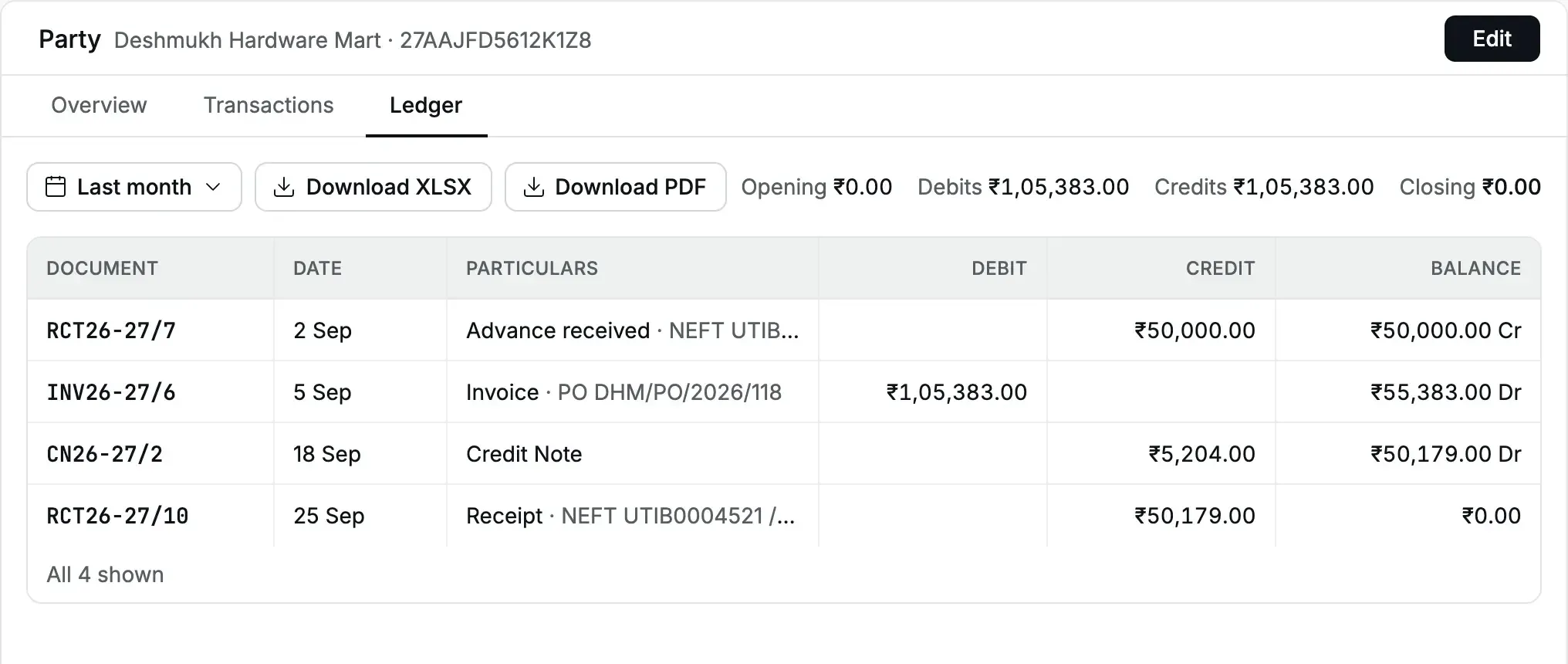
Deshmukh Hardware Mart sends ₹50,000 by NEFT (a bank transfer) against its purchase order DHM/PO/2026/118. No goods have left yet, so this is an advance.
In Receipts → New, choose the party, ₹50,000, Bank transfer, settlement kind Advance, Advance for: Goods, the UTR (the transfer’s reference number) as reference, and the date 2 Sep. Post: RCT26-27/7. See Record an advance.
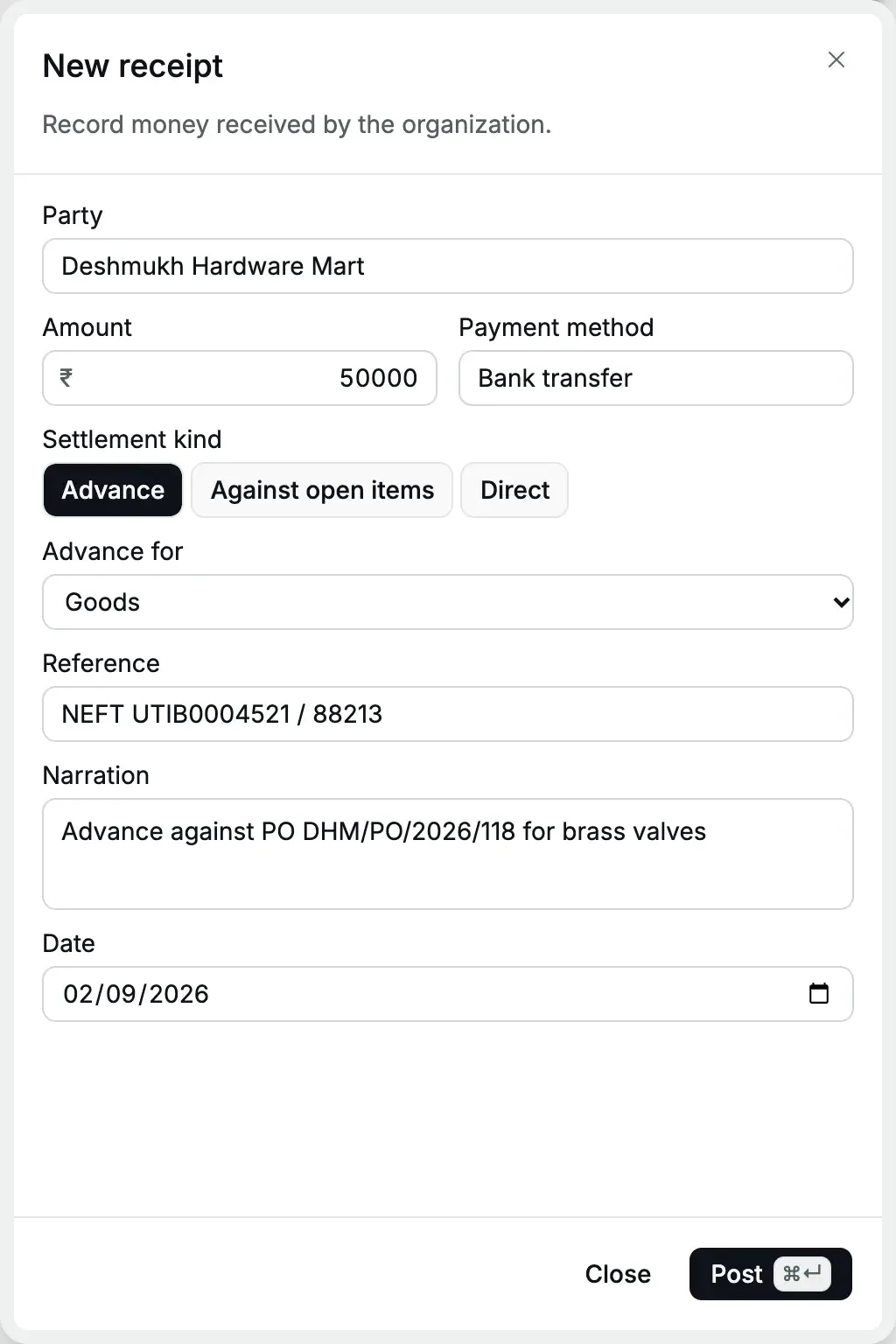
Books: Dr Bank Account ₹50,000 / Cr Customer Advances ₹50,000 (Dr and Cr are debit and credit, the two equal sides of every entry). Deshmukh’s balance is ₹50,000 Cr: Cedar Components holds the customer’s money.
5 Sep: an intra-state invoice with CGST and SGST
The goods go out: 200 valves and 30 packing bags, with a 2% trade discount (a price cut on the invoice). Deshmukh is in Maharashtra, like Cedar Components, so the place of supply is Maharashtra and the invoice carries CGST and SGST (central and state GST, half the rate each).
In Invoices → New, choose Deshmukh, set the due date to 20 Sep, add both lines, choose % and type 2. Save a draft first if someone must check it, then Post: INV26-27/6. See Create an invoice.
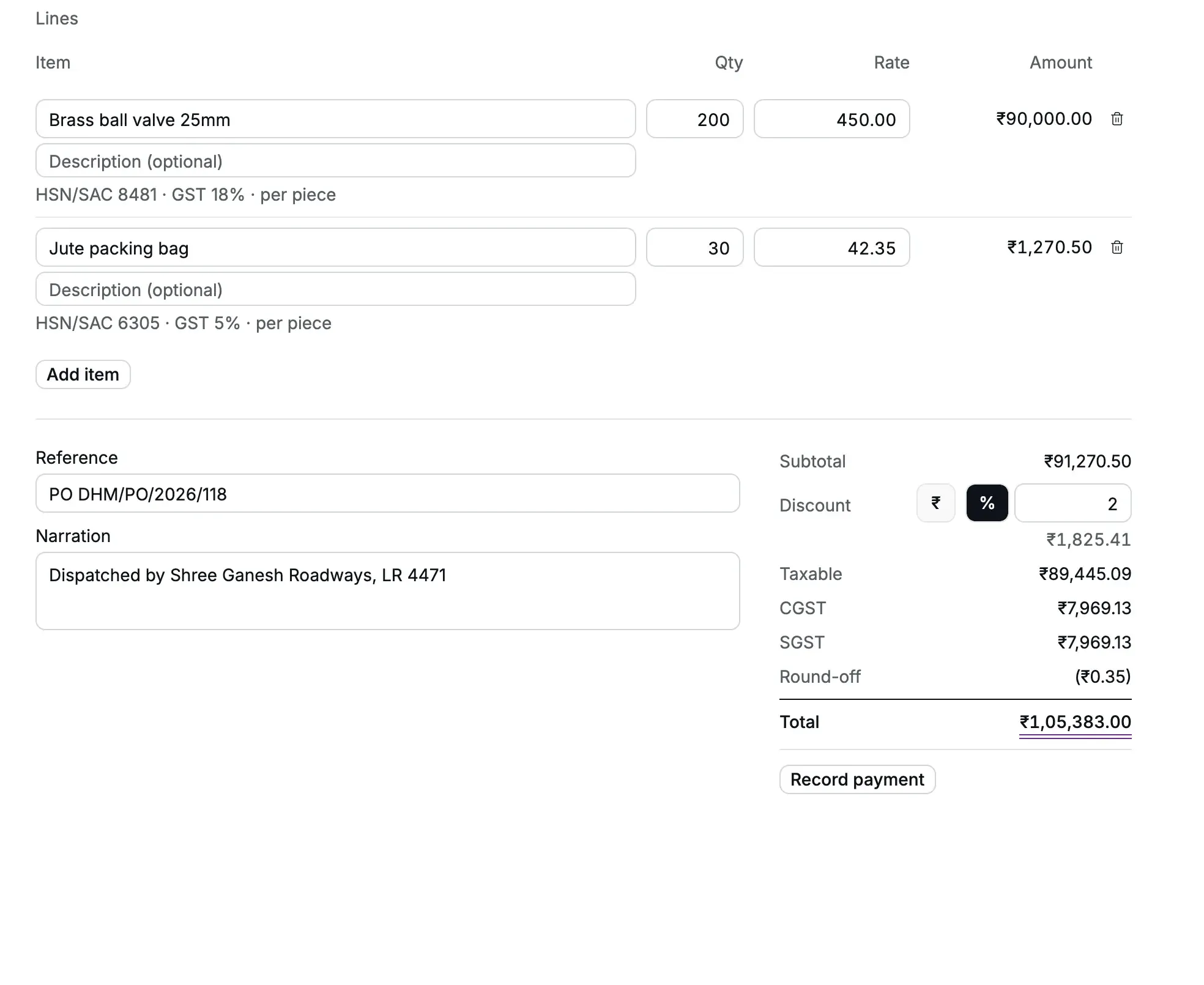
| Valves (18%) | Bags (5%) | Invoice | |
|---|---|---|---|
| Quantity × rate | ₹90,000.00 | ₹1,270.50 | ₹91,270.50 |
| Discount 2% | ₹1,800.00 | ₹25.41 | ₹1,825.41 |
| Taxable | ₹88,200.00 | ₹1,245.09 | ₹89,445.09 |
| CGST | ₹7,938.00 | ₹31.13 | ₹7,969.13 |
| SGST | ₹7,938.00 | ₹31.13 | ₹7,969.13 |
| Round-off | (₹0.35) | ||
| Total | ₹1,05,383.00 |
Books: Dr Accounts Receivable (the receivable account) ₹1,05,383.00 and Round Off ₹0.35 / Cr Sales ₹89,445.09, CGST Output ₹7,969.13, SGST Output ₹7,969.13.
9 Sep: an inter-state invoice with IGST
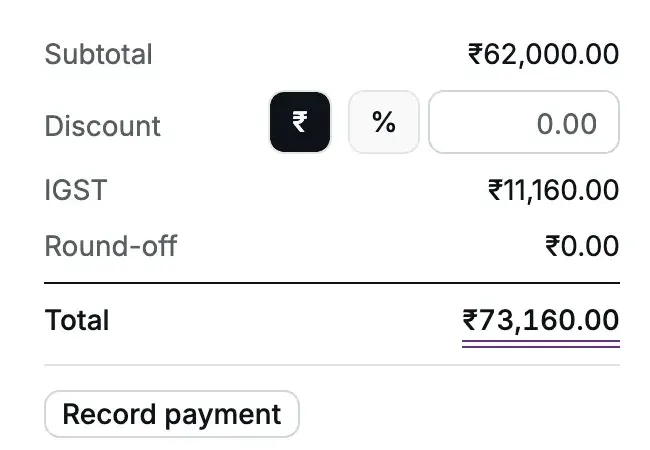
Rao Engineering Supplies orders 50 gate valves, delivered to its site store at Doddaballapur. Rao is in Karnataka, so the place of supply is Karnataka and the invoice carries IGST (integrated GST, charged on sales to another state).
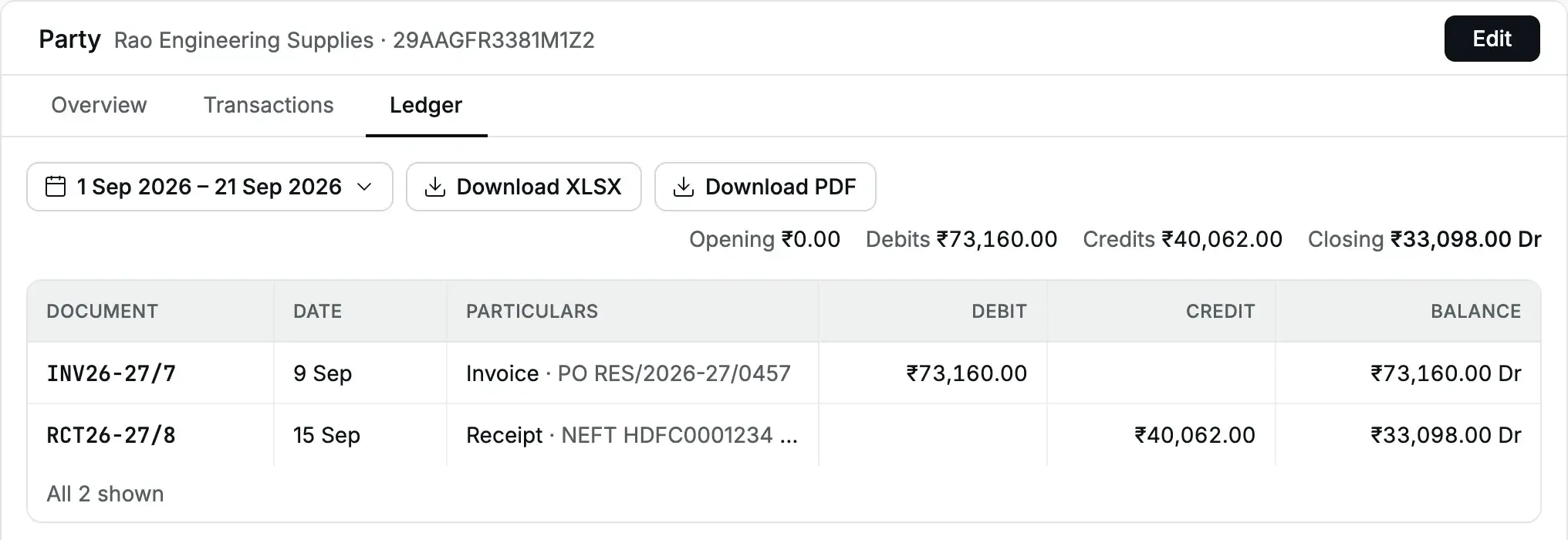
Choose Rao, click Change beside Ship to and type the site address, choose Net 30 in Terms (due 9 Oct), and add 50 gate valves. Post: INV26-27/7 for ₹62,000.00 + IGST ₹11,160.00 = ₹73,160.00.
15 Sep: a part payment with TDS
Rao pays ₹40,000 by NEFT and deducts ₹62 TDS under section 393(1) Table 8(ii), TDS code 1031 (purchase of goods, formerly section 194Q): 0.1% of ₹62,000. Rao deducts it because its turnover and its purchases from Cedar Components this year are above the legal limits. Check with your CA before you assume a customer must deduct it.
In Receipts → New, choose Rao, ₹40,000, Bank transfer, Against open items. Click Add adjustment, choose TDS, type 62. Click Fill on INV26-27/7: it allocates ₹40,062.00. Post: RCT26-27/8. See Fees, write-offs and TDS.
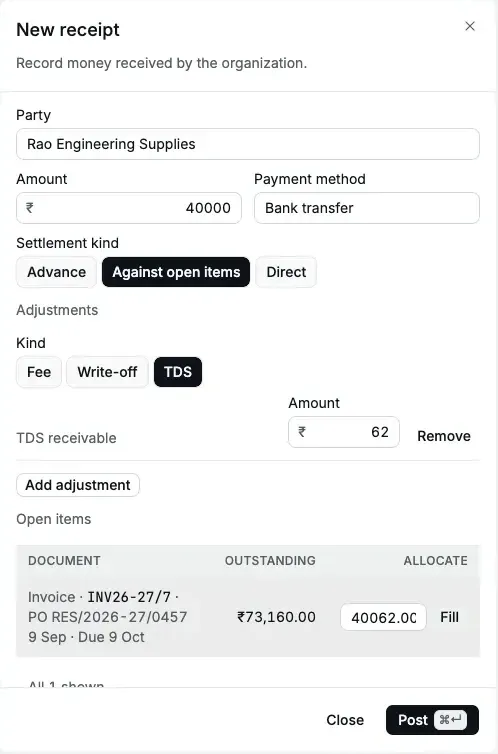
Books: Dr Bank ₹40,000 and TDS Receivable ₹62 / Cr Accounts Receivable ₹40,062. INV26-27/7 is now Part paid with ₹33,098.00 outstanding.
Apply the advance
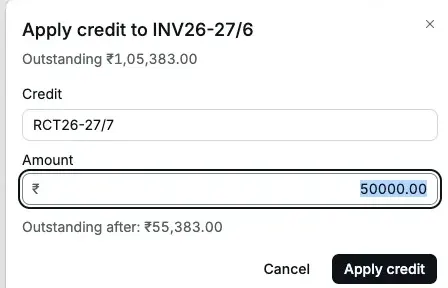
Deshmukh’s ₹50,000 advance should now pay part of INV26-27/6. Open the invoice, click ⋯ → Apply credit (an allocation, matching the advance to the invoice), choose RCT26-27/7, keep ₹50,000.00 and click Apply credit. Outstanding falls to ₹55,383.00. See Apply credit.
18 Sep: a sales return by credit note
A credit note reduces a posted invoice. Deshmukh returns 10 valves that failed a leak test. Open INV26-27/6, click ⋯ → Credit note, set the note date to 18 Sep, and type the taxable value (before GST) on the valve line: 10 × ₹441 (₹450 less 2%) = 4410. Give the reason with the customer’s return note number and click Post note: CN26-27/2. See Post a credit note.
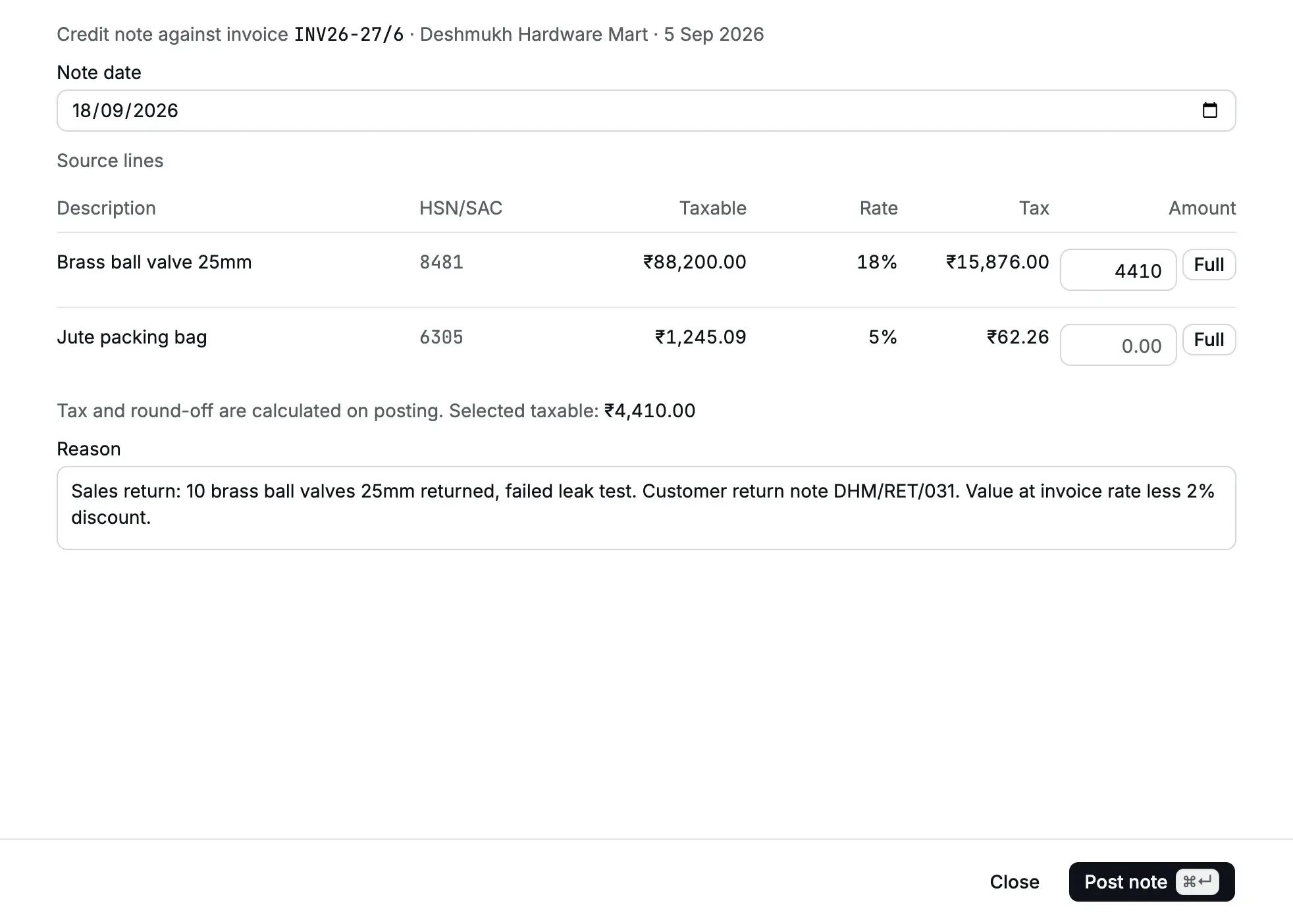
The note is ₹4,410.00 + CGST ₹396.90 + SGST ₹396.90 = ₹5,203.80, rounded to ₹5,204.00. It applies itself to INV26-27/6, which now owes ₹50,179.00.
20 Sep: a counter sale
A walk-in buyer takes 5 valves and pays by UPI (an instant phone payment): a counter sale. In Invoices → New, choose Walk-in customer, add 5 valves (₹2,250.00 + CGST ₹202.50 + SGST ₹202.50 = ₹2,655.00), tick Payment received now, choose UPI and type the UPI reference. Post: INV26-27/8 and its receipt RCT26-27/9, in one step. See Counter sale.
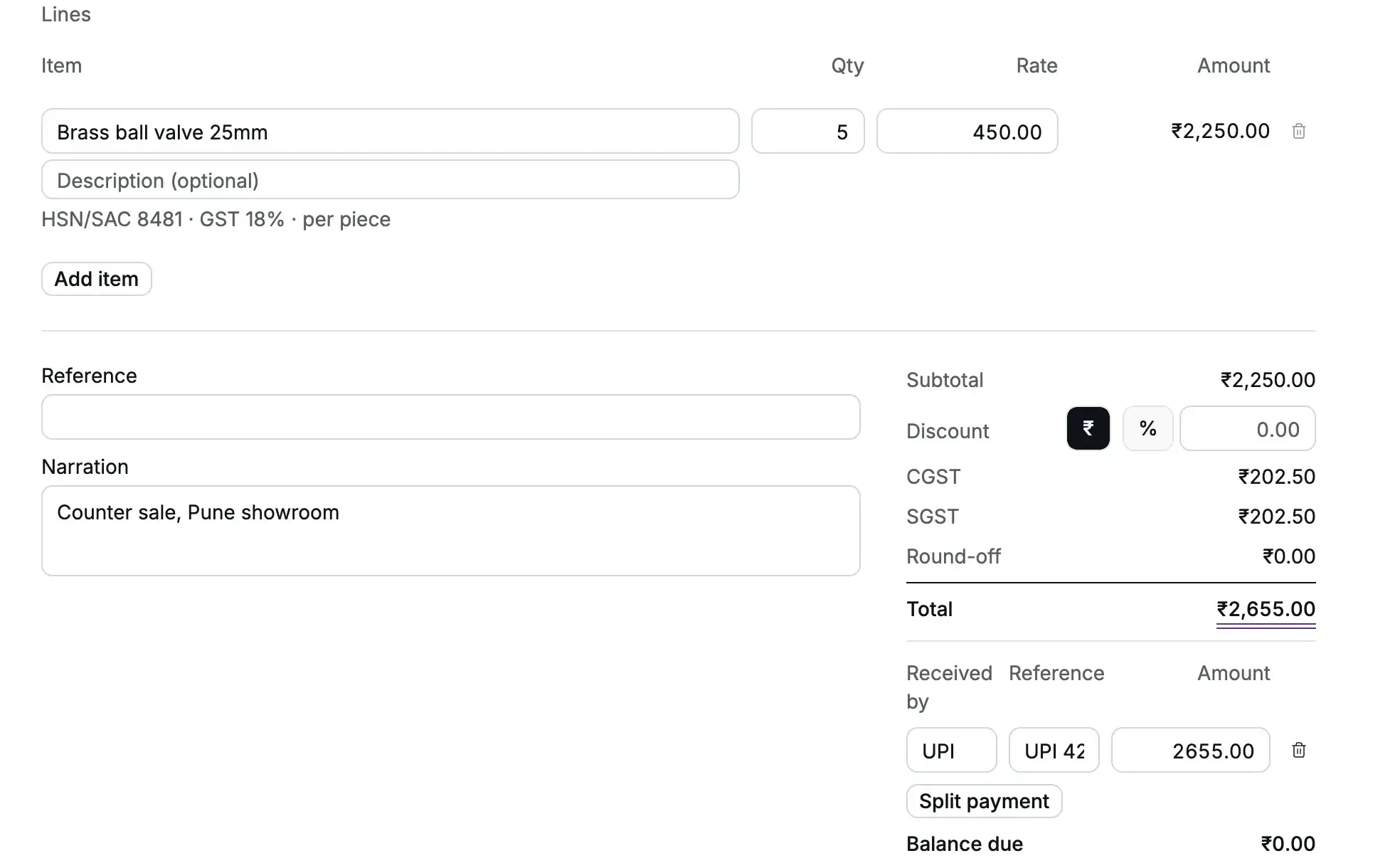
Two days later the buyer returns one unused valve. A credit note against INV26-27/8 (CN26-27/3, ₹450.00 + ₹81.00 GST = ₹531.00) stays unapplied because the invoice is paid, so Cedar Components refunds it by UPI (PMT26-27/6). See Refund the customer.
25 Sep: the balance from Deshmukh
Deshmukh pays the rest. Open INV26-27/6 and click Record receipt: the form fills ₹50,179.00 against the invoice. Add the UTR and the date 25 Sep, and post: RCT26-27/10. The invoice is Paid.
Month end: who owes what
Open Parties. The balance column shows each customer’s position.
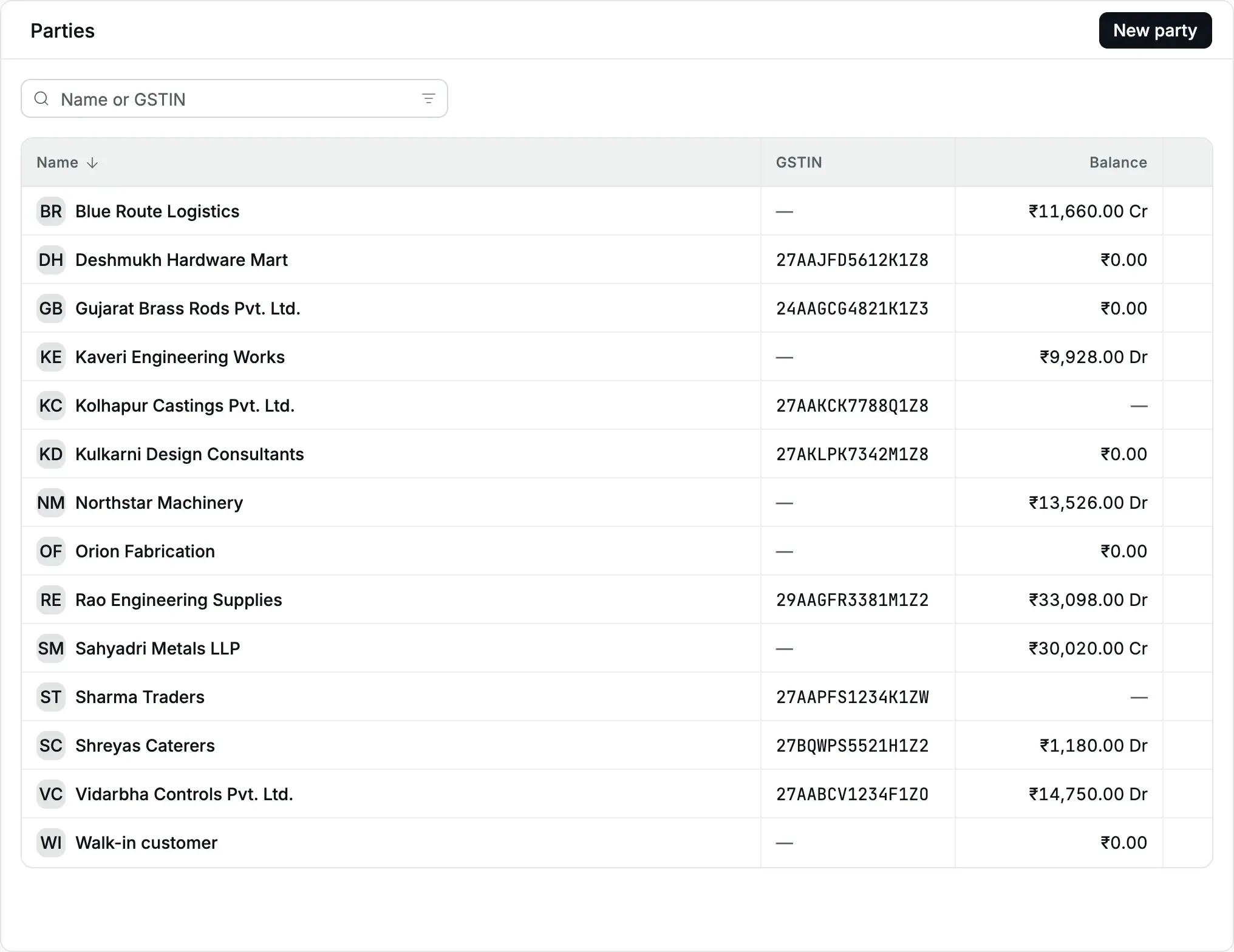
Open a party and its Ledger tab (its ledger, the running list of entries) to see every document (see Party ledger).
| Customer | Billed | Credited | Received (incl. TDS) | Refunded | Balance |
|---|---|---|---|---|---|
| Deshmukh Hardware Mart | ₹1,05,383.00 | ₹5,204.00 | ₹1,00,179.00 | ₹0.00 | |
| Rao Engineering Supplies | ₹73,160.00 | ₹40,062.00 | ₹33,098.00 Dr | ||
| Walk-in customer | ₹2,655.00 | ₹531.00 | ₹2,655.00 | ₹531.00 | ₹0.00 |
| Receivables from this story | ₹33,098.00 |
To chase the open amount, filter Invoices by Status → Open: INV26-27/7 is Part paid, due 9 Oct.
The month in the books
The Output Payable accounts hold the output tax, the GST collected and owed to the government. TDS Receivable holds tax customers deducted that you can claim back.
| Account | Movement from this story |
|---|---|
| Sales | ₹1,48,835.09 Cr (₹89,445.09 + ₹62,000.00 + ₹2,250.00 − ₹4,410.00 − ₹450.00) |
| CGST Output Payable | ₹7,734.23 Cr (₹7,969.13 + ₹202.50 − ₹396.90 − ₹40.50) |
| SGST Output Payable | ₹7,734.23 Cr |
| IGST Output Payable | ₹11,160.00 Cr |
| TDS Receivable | ₹62.00 Dr |
| Bank Account | ₹1,42,303.00 Dr (₹50,000 + ₹40,000 + ₹2,655 + ₹50,179 − ₹531) |
| Accounts Receivable | ₹33,098.00 Dr, once the advance is applied |